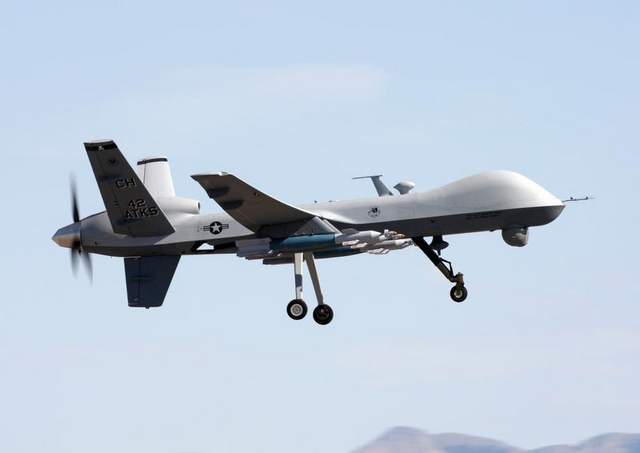

A new policy will allow the widespread export of armed unmanned systems, an Obama administration move to help equip allied nations with the weapons, according to a report in the Washington Post.
The new policy sets guidelines for the foreign nations that wish to receive the aircraft, considered a necessary step due to the human rights records of some of the countries that could benefit.
“The technology is here to stay,” said a senior State Department official, quoted anonymously in the Post. “It’s to our benefit to have certain allies and partners equipped appropriately.”
Read the full report in the Washington Post.
Resource: Read the policy at state.gov.
They also would have to agree to a set of “proper use” principles created by the United States, promising to use the drones for national defense or other situations in which force is permitted by international law. The drones are not to be used “to conduct unlawful surveillance or [for] unlawful force against their domestic populations,” an unclassified summary of the new policy said.
“If you fall back on what our objective is, it’s really more than anything to provide an extra level of scrutiny with respect to these transfers,” the official said.
[Related: Panel warns of ‘unintended consequences’ of U.S. drone policy]
Foreign governments also will have to accept potential U.S. monitoring of how the drones are used.
The new policy covers both armed and unarmed drones and builds on the Obama administration’s update last year to rules on conventional weapons transfers, which emphasize human rights protections in decisions about arms sales.
The policy may nevertheless heighten concerns among rights groups, which maintain that the remote strikes have killed civilians without proper U.S. accountability.
The policy also may face some opposition in Congress. Like all major weapons sales, drone exports above a certain dollar value would be subject to congressional notification, giving lawmakers an opportunity to hold up some if they have concerns.
In 2012, a State Department plan to arm U.S.-made drones owned by Italy drew objections from Sen. Dianne Feinstein (D-Calif.).
“Despite the best intentions, we will not be able to guarantee that purchasers of U.S. UAVs [drones] will be able to develop the same level of intelligence to discriminate between potential targets, take the same level of care to limit the number of innocent civilians killed, or follow our restrictions against assassination,” Feinstein wrote in a letter to then-Secretary of State Hillary Rodham Clinton.
Micah Zenko, a scholar at the Council on Foreign Relations, said the new guidelines fill a gap in U.S. policy, given the growing global reliance on drones for military, surveillance and law enforcement purposes.
“The important thing to know with armed drones is that based on America’s record, they lower the threshold for when countries use armed force,” Zenko said. “And when you have that lower threshold, it can change the calculus of countries.”
[Graphic: How drones are controlled]
There is likely to be additional congressional scrutiny in the wake of the Islamic State’s seizure of much of Iraq this summer, and with it millions of dollars in U.S.-made military equipment that had been provided to Iraqi security forces.
The United States has long taken a secretive approach to its use of drone strikes. In 2013, President Obama nudged the drone program partly out of the shadows when he called the strikes an effective tool when foreign governments cannot or will not address militancy within their borders.
A green light to sell drones overseas would help U.S. firms gain a larger foothold in the global drone market that Steve Zaloga, a senior analyst at the Teal Group Corp., an aerospace research firm, said is now worth more than $6 billion a year. The new policy also covers the export of commercial drones. China and Israel are actively promoting their drones to foreign buyers.
Zaloga said drones commonly used by the U.S. military, such as the Reaper, can cost $10 million to $15 million.
Officials said it would take months, but not years, to approve requests.
Greater drone capability for U.S. allies also could ease the high demand for U.S. surveillance flights, particularly in the Middle East. The Air Force is grappling with a shortage of drone pilots and other military specialists needed to run drone operations.
Craig Whitlock contributed to this report.
Missy Ryan writes about the Pentagon, military issues, and national security for The Washington Post.
- class=”left facebook” data-sharetype=”facebook”>Share on Facebook
- class=”right twitter” data-sharetype=”twitter”>Share on Twitter
39
Comments
Get Checkpoint
Twice-weekly updates delivered just for you.