-

Blue Origin wins protest against US Air Force’s procurement plan
Earlier in the year, Blue Origin raised concerns to Congress that the contract award, currently planned for 2020, should be delayed for up to two years to allow competitors to further mature their designs.
-
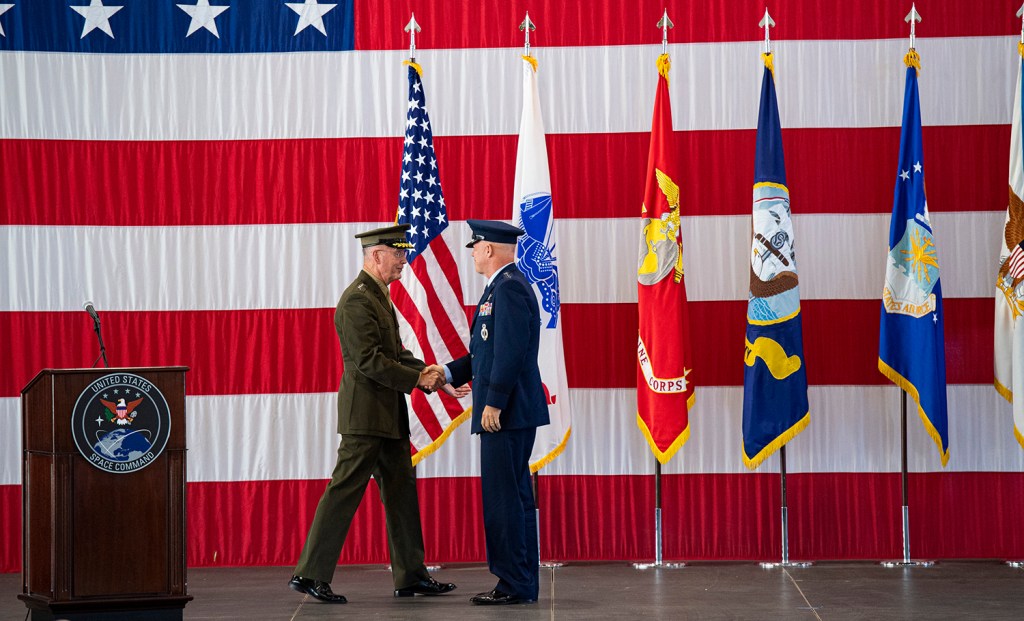
US Space Command is here. Now where does it need to go?
Plans for US Space Command began with five people locked in a room in San Antonio. Now, the newly established eleventh combatant command is set to grow to 500 people as it comes into its own.
-

How the Space Cybersecurity Working Group fosters communication
The group formed by the National Security Council is working to implement the Trump administration’s cyber strategy in space.
-

All systems ‘Go’: How China plans to control space
In order to understand China’s military approach to space, look to the ancient board game of Go, says the head of the Defense Intelligence Agency.
-

How the Air Force plans to find ‘defense unicorns’
At the first Space Pitch Days, the Air Force wants to find nontraditional companies with innovative solutions for the military.
-

What the Air Force can learn from these experimental satellites
Cubesats designed and built by the Aerospace Corporation will show how viable it is for the military to build a constellation in low earth orbit comprised of hundreds of small satellites built with commercial technology.
-

Who will help track hypersonic threats from space?
The Missile Defense Agency has tasked these four companies with designing a space-based sensor capable of detecting and tracking hypersonic weapons.
-

Who will be able to fix a satellite for the Air Force in 2025?
The Space and Missile Systems Center wants to know what commercial on orbit servicing capabilities will be available in 2025 that can make Department of Defense satellites more resilient.
-
Blue Origin wins protest against US Air Force’s procurement plan
Earlier in the year, Blue Origin raised concerns to Congress that the contract award, currently planned for 2020, should be delayed for up to two years to allow competitors to further mature their designs.
-
US Space Command is here. Now where does it need to go?
Plans for US Space Command began with five people locked in a room in San Antonio. Now, the newly established eleventh combatant command is set to grow to 500 people as it comes into its own.
-
How the Space Cybersecurity Working Group fosters communication
The group formed by the National Security Council is working to implement the Trump administration’s cyber strategy in space.
-
All systems ‘Go’: How China plans to control space
In order to understand China’s military approach to space, look to the ancient board game of Go, says the head of the Defense Intelligence Agency.
-
How the Air Force plans to find ‘defense unicorns’
At the first Space Pitch Days, the Air Force wants to find nontraditional companies with innovative solutions for the military.
-
What the Air Force can learn from these experimental satellites
Cubesats designed and built by the Aerospace Corporation will show how viable it is for the military to build a constellation in low earth orbit comprised of hundreds of small satellites built with commercial technology.
-
Who will help track hypersonic threats from space?
The Missile Defense Agency has tasked these four companies with designing a space-based sensor capable of detecting and tracking hypersonic weapons.
-
Who will be able to fix a satellite for the Air Force in 2025?
The Space and Missile Systems Center wants to know what commercial on orbit servicing capabilities will be available in 2025 that can make Department of Defense satellites more resilient.