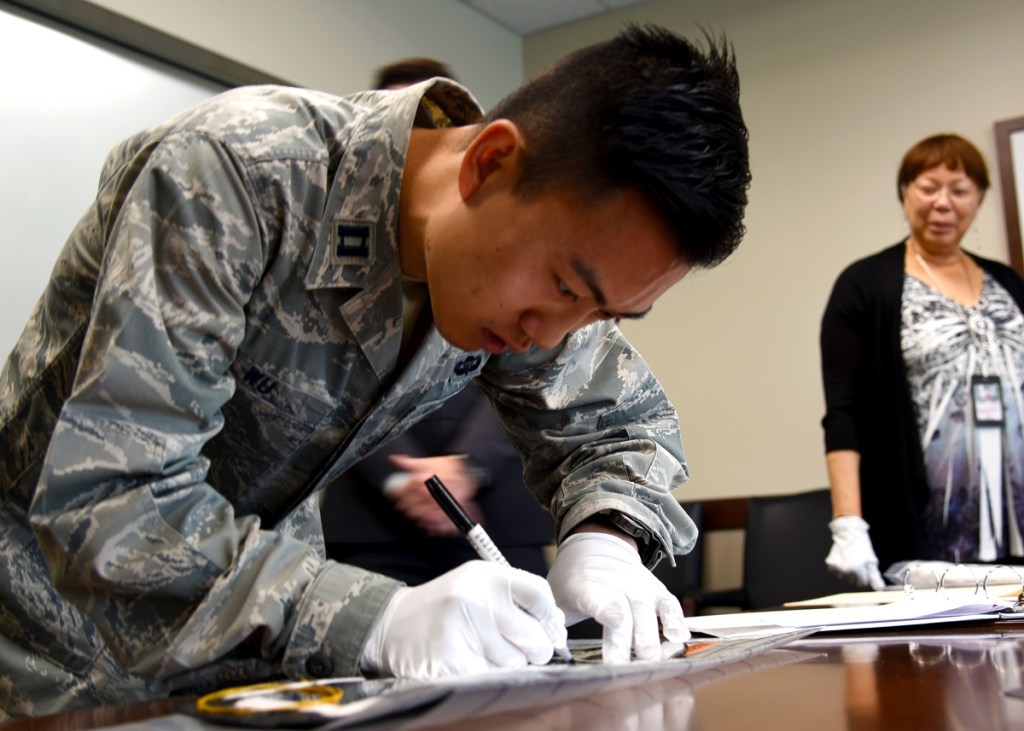
The Air Force will launch its next highly protected communications satellite in October, but leaders from Lockheed Martin and the Department of Defense met recently to continue an unusual tradition: they signed a space blanket.
A what?
On June 22, leaders from the Air Force Space and Missile Systems Center, the Aerospace Corporation and Lockheed Martin Space Systems autographed the thermal space blanket that will travel inside a satellite.
The thermal space blanket will be wrapped around part of the Air Force’s Advanced Extremely High Frequency (AEHF)-4 satellite as a way to help regulate temperature and prevent rapid temperature change. Thermal blankets, like the one that will travel with AEHF-4, were initially developed by NASA in 1964 and are highly reflective. They are also regularly found in emergency kits or used by long-distance runners to prevent rapid temperature change.
Signing the thermal blanket continued a tradition from previous AEHF satellites and the legacy Milstar satellite program, which preceded the AEHF program.
The AEHF program consists of six satellites that provide communications for high-priority military ground, sea and air assets. Most recently, AEHF-3 launched in 2013 and the first satellite in the program, AEHF-1 launched in 2010.